So you are going to a protest rally. Maybe you are someone who never misses any protest, feeling at home in the organized crowd. Or maybe you have finally gotten up the courage and the frustration to step out in public. The protest rally is for most people the most available and easiest entry into the contemporary political sphere. It asks very little of the participant. You can join in chants or not, you can listen to speeches or just enjoy the time outdoors with like-minded people. There is safety in a crowd, and a reinforcement of the beliefs and concerns that motivated you to set aside some time.
But have you thought about the sign you will carry?
Key ideas in this essay:
• There are many kinds of signs, each with a different intended audience and a different potential impact.
• An effective protest will have a mix of signs, but too much of some sign types might dilute the protest’s impact.
• Artistry in sign-making doesn’t matter as much as thoughtful staging does—that is, the mix of signs and how they are used or displayed.
The messaging of the contemporary rally is refreshingly organic. There are far fewer prepared signs than would be seen at, say, a speech by a political candidate. So you get to choose what you will say. You might make your sign at home, writing messages on spare pieces of cardboard. Sometimes rally organizers will set up a table with blank signs and markers. In the democratic spirit of the rally, anyone can write whatever they want. We might think of a slogan we’ve seen before, perhaps on social media, or we might just try to say what we feel, in just a few words.
But maybe you want to be a bit more intentional, and try to use your sign for maximum impact. What follows is a guide to the contemporary protest sign: what it can do, and what the choices are as we make them. A well-planned sign can shape the impact of the protest.
A sign at a protest has three possible functions.
Since the rally is directed against something, or defends something against the predations of the powerful, signs can communicate to the other side (e.g. those in power). They show that some people dissent, and identify their grievances.
Signs can communicate to observers, passersby who might be open to the message, explaining the cause and representing the emotions of the protest. Naturally, passersby want to know what the protest is about. They can also gauge the tenor of the protest: is it something that I would want to join, and would I be welcome? Is it likely to be peaceful or to turn violent?
The third purpose of a sign is to communicate with those around us, in an emotional way. We signal to our neighbors that we are like-minded, offering subjects and feelings we can agree on or discuss.
So the first thing to think about is which of these purposes feels right or appropriate as you craft your sign. Do you want to talk back to power, broaden the support for protest, or tighten bonds at the protest? Each of these are important, but your sign will achieve one of these more than the other goals.
Next comes the type of message. Below, I identify nine types of signs, using examples from recent rallies, to consider the value and the impact of each type.
1. The cause
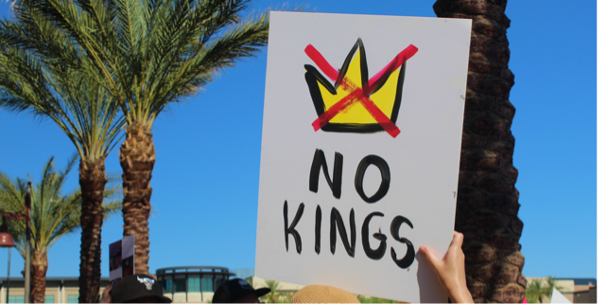
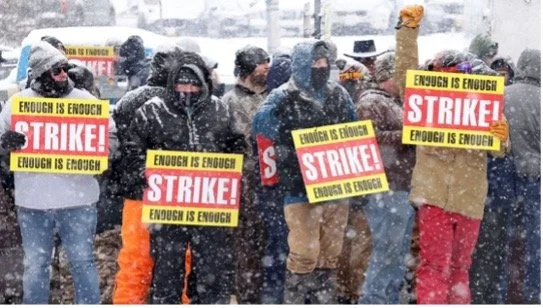
This is the essential sign. Everyone can know why we are there on the street. It is important to convey, in as few words as possible, what the cause is. These signs allow the casual observer, from across the street or in a passing car, or watching television, to identify the protest and distinguish it from others. It also helps us orient ourselves as we approach the crowd.
Should there be only one cause represented? Do signs advocating multiple causes muddy the message, or provide valuable diversity? Ideally, different causes should relate in some way to one another, so that the observer sees not chaos but complexity. For example, showing up at a No Kings rally with a sign protesting the rezoning of a local land parcel will only confuse and diminish the protest. On the other hand, a sign calling for the justice system to do its job in exposing corruption expands the scope of the protest in a logical way. A special type of cause sign is the “Honk if you…” sign: invite passing drivers to show their support. This sign only works if the message is clear and simple (so a driver knows why they should honk), and there aren’t various “honk” messages in competition with one another.
2. The explainer
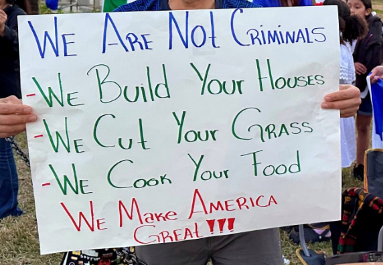
An explainer sign is like a portable version of the popular yard sign: “In this house, we believe that…” (In fact, some people simply pull this sign out of their garden and bring itto a protest.) We live in an era of disinformation, and we know that many people simply do not know the facts. But an explainer sign takes a long time to read, and even longer to process. It isn’t ideal for a street protest, because it repeats the obvious for participants, is of no interest to opponents, and is most likely tl;dr for the casual observer.
I suspect that explainer signs are proliferating in part because they fill a need left by the decline of the flier. Ideally, a protest should be a place to pick up more informationto digest later, but contemporary protests tend not to have any organized leadership that could coordinate the composition and printing of leaflets. Putting that same information on a sign is not as effective, because it requires the reader to stand awkwardly in one place to read and process; it is easier simply to move on. One way to use an explainer sign effectively is to stand near a stoplight, and walk across the street in front of cars stopped at a red light.
3. The demand
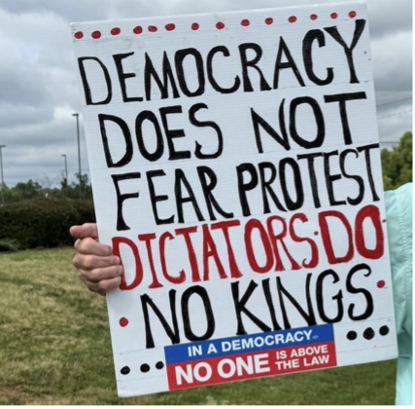
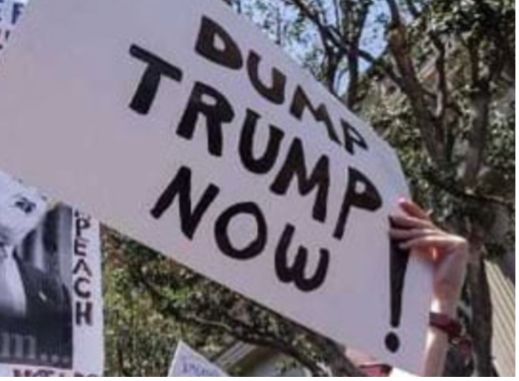
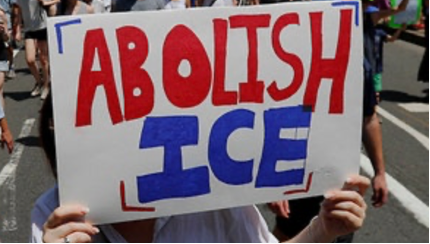
Signs with demands lie halfway between the sign that identifies a cause and those that seek to explain beliefs. Like identifiers, they can be straightforward and easily understood: “Abolish…!” “Shut down…!” “Free…!” While an observer might wonder “How?”, that is beyond the task of a protest. The other thing to keep in mind is that maximalist demands, if voiced, can come to define a protest, crowding out less dramatic demands.
They are like explainers in that it is hard to resist the temptation to multiply demands, to list all the things protesters hope will happen. As an example, it is not uncommon to see at anti-ICE demonstrations signs adding “Release the Epstein files.” Of course, it is important to keep many demands in sight, and not all will get their own protest opportunity. But the risk is that by multiplying the aims the protest muddles the message.
4. The joke.
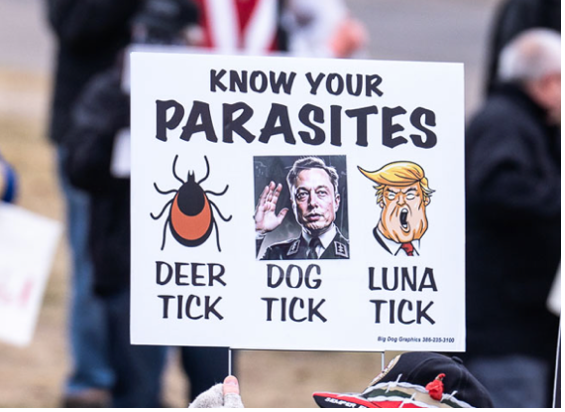
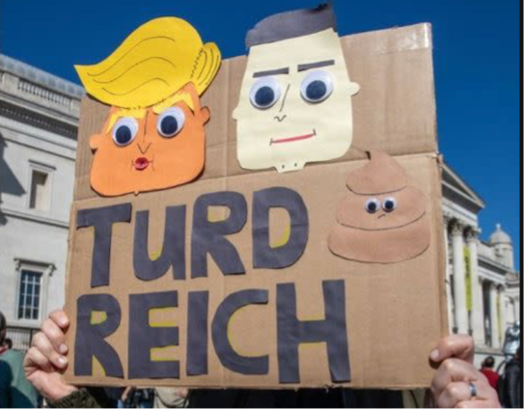
The joke sign has become very popular in recent protests. Perhaps this is driven by meme culture and by the jokes of late-night television hosts. Joke signs are like the explainer signs in some ways, with the same downsides: they don’t offer a goal, and they might not be clear at first glance. They often rely on in-jokes that the casual observer or participant might not get. On the other hand, a joke sign is a low-stakes way to enter a protest. You don’t have to make a demand, and you can show that you ‘get it.’ So a joke sign enhancesthe protest community. We can read each other’s signs and share a good laugh. Still, to the extent that they are directed at the converted and don’t build up shared values, they are probably the least effective type of sign at a protest.
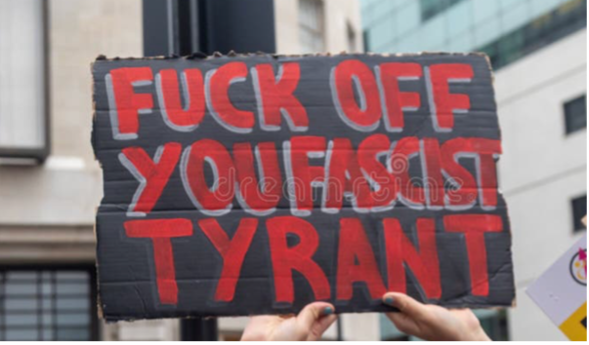
5. The expletive
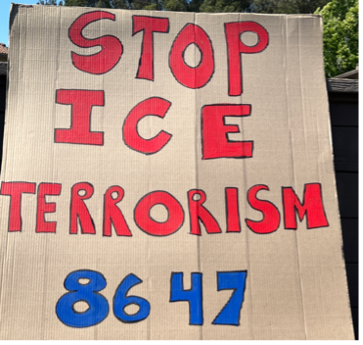
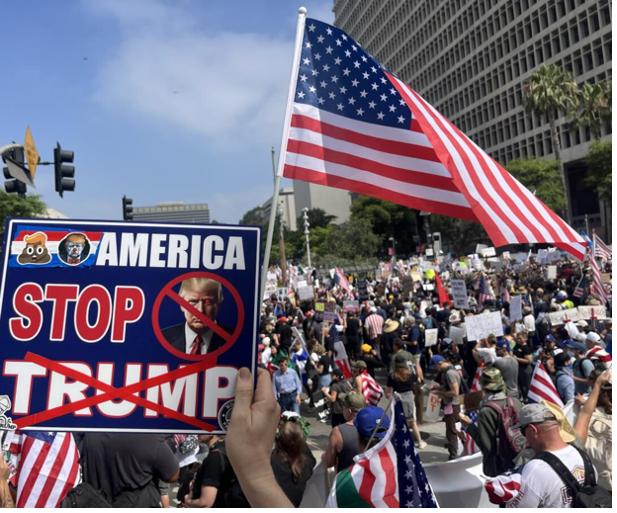
Like the joke sign, these often rely on memes and in-jokes. Not everyone will know what “86-47” means, after all; it might feel somehow safer to express this than “Fuck Trump,” but at the risk that not everyone is as online as you. The angry sign is cathartic, and direct, meant to be read by the object of the protest as well. Without question, the angry sign energizes the protest, giving participants a necessary feeling of catharsis. On the other hand, an angry sign may not welcome casual observers to a protest, and could even feel uncomfortable. So some balance is needed: a rally with nothing but angry signs would be very different from one with a few such signs.
6. The identity sign
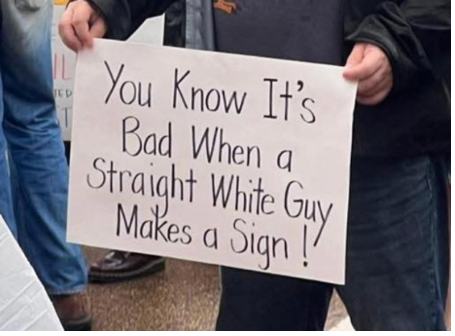
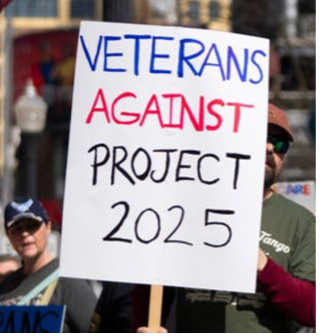
It seems many participants in recent protests want to identify themselves. Like a joke sign, this might be an safe entry point to protest: you are simply introducing yourself. In theory, an identity sign can draw observers in while saying something about the protest. “Veterans Against Trump,” for example, tells us that the rally includes people who have demonstrated service to the country; observing veterans or soldiers might be more interested in participating. Similarly, a “Trans people for change” could also be welcoming; a trans observer could go stand with that person as an entry into protest. But what about “You know it’s bad when a straight white guy makes a sign”? This sign tells the viewer about the person holding it, but does it do anything more? It is a somewhat humorous, self-effacing comment on protest, but the humor is not likely to inspire any action.
One question is whether identity signs show that a wide range of people is united in protest, or contributes to disintegration of community in favor of identity groups with no discernible separate agenda.
7. The virtue signal
Displays of common virtue are a powerful part of any protest. They are like identity signs in that they send a message about those who carry them. But they do so much more: they can build a sense of common purpose, while also sending an important signal to any observer. They are not displayed casually, because they usually imply that the other side does not have the right to these symbols.
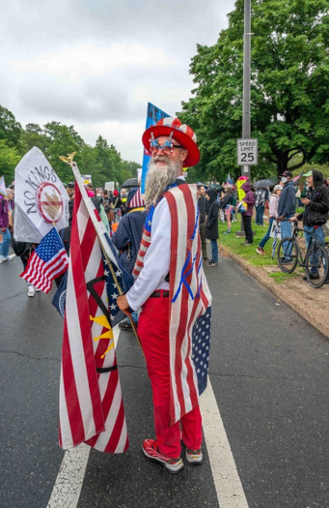
There are two enormously powerful virtue symbols that protesters display. First, flags. National flags tell a powerful story. Their symbolism is impossible to miss, even if they can be deployed by opposing sides, each seeking to claim the mantle of patriotism. The ubiquity of American flags at the October No Kings rally—no doubt partly in response to House Speaker Mike Johnson’s insinuation that protestors “hate America”—signaled a set of virtues claimed by the protestors. Significantly, many observers in passing cars also waved American flags in support.
Some protesters display the American flag upside down. While this is an accepted way of signaling distress or opposition, it also confuses. Not everyone recognizes this as a symbol of distress – obervers are just as likely to as assume that the protester intends disrespect.
Another common virtue symbol is the cross. It signals to the observer that the protest enjoys or claims God’s benevolent protection—and also, perhaps, that the protesters identify as martyrs for a cause as was Jesus, and that they are persecuted by opponents who don’t share their faith. The cross is an unwieldy protest symbol because it is difficult to control its meaning. To indifferent or antagonistic observers, the cross obscures the cause itself. Sympathetic observers, in turn, might feel that the cross is inappropriately deployed in a secular setting. Most likely, these concerns matter little to those who choose religious symbols as vehicles in political protest.
8. The performance.
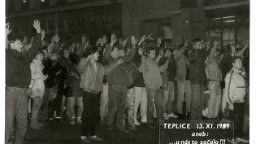
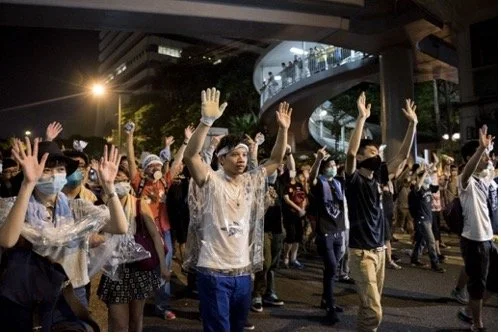
When Czechs stood up to Communist police in November 1989, some chanted “Our hands are empty,” that is, they were unarmed. Similarly, demonstrators in Ferguson, Missouri in 2014 chanted “Hands up, don’t shoot,” to convey the same message; protesters in Hong Kong the same year borrowed the gesture. In each case, the crowds were gesturing to draw a contrast with an aggressive regime.
Sometimes, then, a demonstration can make its point without signs—as also when clergy, women and/or children are placed at the front of a march. It is important to convey the mood and style of a protest, to help others understand it. These gestures resonate in the media. It sometimes happens that they disarm the regime’s forces. Leon Trotsky, in his history of the Russian Revolution, imagines a moment in February 1917 when an older woman catches the eye of a soldier on horseback and challenges him: he could be her son, and he knows people don’t have bread. He lowers his rifle, and the army starts to turn away from confrontation.
The classic way to show peaceful intent is with a flower (or a candle). A flower is not visible at any distance, but can be handed to a policeman, as has been done in many a protest. There is one more prop that makes a protest memorable.
9. The costume.
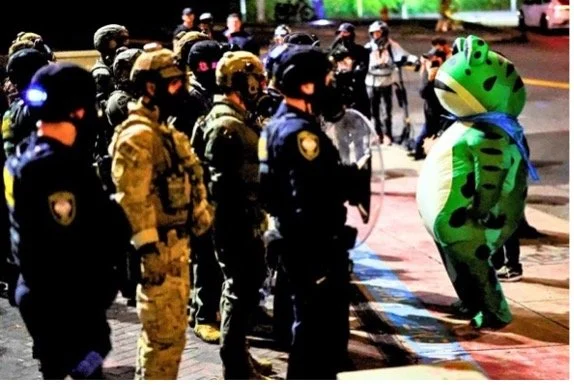
When protesters wearing inflatable frog costumes showed up at an anti-ICE rally in Portland in October, it seemed to many like just an example of Portland being weird. The frog has no message, after all. But when an ICE officer pepper-sprayed one the frog became a viral sensation—especially when the frog, 24-year-old Seth Todd, summed up the experience by saying “I’ve definitely had spicier tamales.”
Why is this so important? The inflatable costume—and so many previous silly outfits sported by protesters in history—accomplishes things that no sign can do. First, it makes the protest instantly visible in a non-threatening way. Even from a speeding car one can spot the frog and laugh. Approaching on foot, the frog (unicorn, dragon, chicken) is welcoming in a way that a sign might not be. You don’t have to talk to the frog if you stand next to it, but you have to engage the signholders around you.
But what politics does the frog serve, you might ask? The frogs (and their cousins) come into their own precisely when the regime is threatening or beating protesters while accusing them of aggressive tactics (“terrorists,” e.g.). As ICE discovered, like many regimes before, it is hard to attack someone in a silly costume. When you do, you look foolish. The frog thus reverses the power relationship, subordinating the powerless police to the untouchable, innocent-looking protester.
We find ourselves today in a moment where dialogue with the regime is impossible. But the success of resistance depends upon many things. One of these is the clarity and force of its message. That is essential to growing the ranks of those willing to show up, as well as those who support from a distance. The goal of demonstrations is to show society, and the regime, that protest is a popular and accessible action, not something of interest only to the fringe. To that end, the choice of protest sign or costume may make all the difference.
Protests are a performance, and are hard enough as it is to organize. What they often miss is staging. Demonstrations and marches in 2026 are not like those of the past, when someone—a union, a civil rights organization, or a political party—managed the message and the shape of the event. Today, for better or for worse, we all contribute to the message. We don’t need to be great artists or craft memorable memes. We should try to add to the total message of the gathering, however. Thinking about what we put on a sign, the costume we wear, or the gestures we choose to make, will make all our voices louder and clearer.